

August 14, 2024
Even the most ideal life is marked by inevitable change. At the forefront of it all are our finances. Our income, our debts, our savings, and our investments all matter and must match the twists and turns our financial paths might take.
When it comes to managing these pieces in sync with our life stage, one investment tool often overlooked is the IRA, an individual retirement account. While an IRA is a long-range strategy designed for the future, it is not a “set-it-and-forget-it” one. To reap the greatest benefit from your IRA, you must know how to manage one properly as your life changes. **

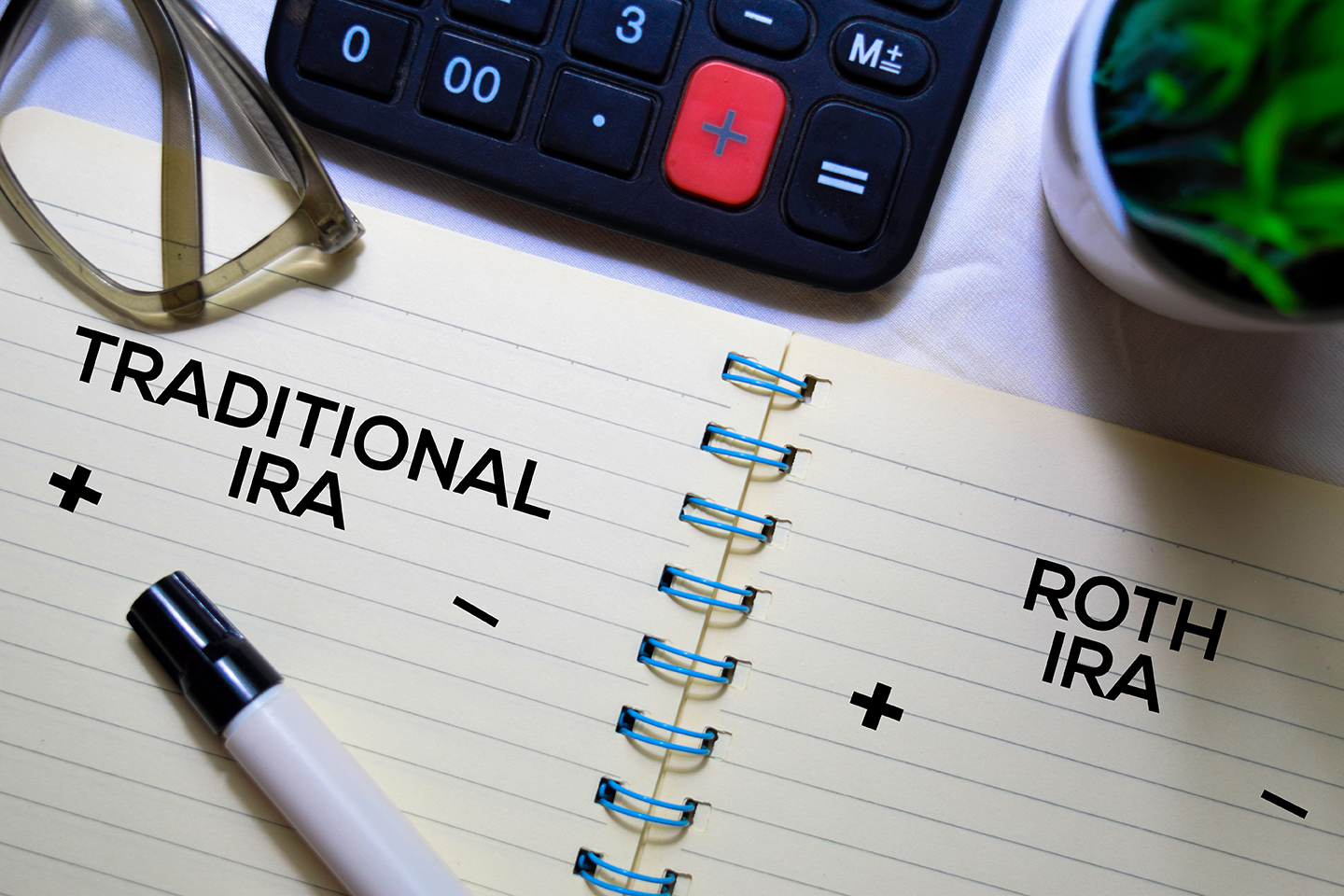
Traditional IRA Versus Roth IRA
IRAs are basically interest-earning savings accounts that allow you certain tax advantages if you put away a certain amount of money over the course of a year for a point in the somewhat distant future —ideally sometime after you turn 60. The two most common types of IRAs that most of us invest in are referred to as traditional IRAs and Roth IRAs. While the annual contribution amount allowed is the same, the two types of IRAs have some significant differences:
- Traditional IRAs are tax deferred. You contribute pre-tax money, and contributions are tax deductible as long as your tax status, job-related retirement benefits and income fit within certain guidelines. Withdrawals of distributions are taxed, and while you can begin taking distributions once you turn 60, you must start taking required minimum distributions in the year you turn 73 — in 2033, the upper age limit increases to 75.
- Roth IRAs are funded with after-tax money. This means disbursements are tax free. However, contributions to the account are not tax deductible. Roth IRAs have higher income caps compared to traditional IRAs, and they have no required minimum distribution deadlines.
Deciding which type of IRA will serve you best really depends on where you are in your life and where you might want to go. **
Four Life Events That Require IRA Management
Because eligibility for various types of IRA investments is so closely tied to how much money you make, your employment benefits, and your marriage status, simple life events can impact not only that eligibility, but also how much of a benefit an IRA may offer. Any significant life event can change your MAGI (your modified adjusted gross income) and is an appropriate time to review your IRA holdings and consider whether a change might be beneficial to your bottom line.
1. Getting a Job or Switching Jobs
Accepting that first real job immediately places you at a certain income level with certain benefits like a workplace retirement plan, for example. It’s important to know exactly where it places you and your MAGI on the eligibility scale for IRAs so that you can start saving. The sooner you begin saving, the more time your funds will have to grow through compound dividends.
As you move through your career, however, promotions or new jobs with new benefits could eventually rob you of tax benefits you initially enjoyed. Likewise, a lateral move, pay decrease or benefits change, could actually give you benefits in which you were previously ineligible. So, your savings strategies need to match your career path.
While a traditional IRA might have served you well at first, as you progress you may find switching to a Roth IRA more advantageous. You can keep your traditional IRA investment and open a new Roth or convert your traditional IRA into a Roth. You may have to pay taxes on the transition, but a Roth rollover has no income limits, and there’s no limit on the amount you can roll over from a traditional IRA into a Roth. Because Roths have no minimum disbursement requirements, they can even be left as part of an inheritance.
2. Paying Taxes
Remember: Consult your tax professional to see what specific tax advantages apply to your situation. La Capitol is not a tax advisor.
Many of the advantages associated with IRAs are due to their relation to taxes. Contributions to traditional IRAs are tax deductible as long as you fit within the IRS MAGI guidelines. While contributions to Roth IRAs use after-taxes money, withdrawals and disbursements are tax free.
In some cases, you may find that you can actually save yourself significant taxes—and increase your tax refund significantly—simply by contributing the annual allowable amount to a traditional IRA. Even if you can’t contribute the entire amount, contributing just half might make a worthwhile difference to your bottom line.
According to the tax laws, you can contribute at any time during a tax year including any time up until that year’s tax deadline. For example, for 2024, you could contribute to an IRA at any time during 2024 as well as any time in 2025 up until Tax Day in April 2025. When you’re doing your calculations to file your taxes, be sure to see how much an IRA contribution might help with the bottom line.
3. Getting Married
Remember: Consult your lawyer to see what specifics apply to your situation. La Capitol is not a legal advisor.
Changing your status to married filing jointly raises the MAGI limits and allows both you and your spouse to invest in your own IRAs. However, just as the benefits you have with your job affect your MAGI limits, your spouse's benefits may affect your MAGI as well. Specifically, if you don’t have a retirement plan at work, all of your contributions to a traditional IRA have been tax deductible. However, if you get married and your spouse has a retirement plan through his or her work, that affects you. The limit is still higher than the standard married filing jointly figures, but a limit does exist.
For married couples who file separately, IRAs can become quite complex. If your MAGI is $10,000 or more, you’re not eligible for a Roth IRA, and you’ll get no deduction for a traditional IRA contribution. If your MAGI is under $10,000, you may be eligible for partial contributions or deductions. There is an exception for married filing separately individuals who did not live with their spouse at any time in a year. Those individuals may be able to contribute to a Roth IRA under the same guidelines that apply to single and head of household filers.
If your spouse does not work, you can open a spousal IRA in their name and contribute to it for them. The rules are fairly simple. Your tax status must be married filing jointly. Your combined IRA contributions cannot exceed the working spouse’s income. You still have to follow the IRS IRA MAGI guidelines regarding income and tax deduction eligibility. Since your spouse’s name is on the account, your spouse owns the account even though you are the one making the financial contribution.
Finally, always make sure that you’ve identified a beneficiary on your IRAs — especially if you’re married. Denoting a beneficiary avoids the delays and fees associated with probate and possible creditors and ensures your spouse can have the benefit of lifetime distributions rather than a lump-sum payment. Your spouse can also roll over your IRA into a new account, resetting the required minimum distributions to their own age.
4. Getting Divorced
Remember: Consult your lawyer to see what specifics apply to your situation. La Capitol is not a legal advisor.
IRAs are often a priority in divorces and may be divided as part of the settlement. Federal law allows tax-free transfers if a transfer is part of your divorce decree or property settlement agreement and as long as the funds are transferred directly from one spouse’s IRA to the other spouse’s IRA.
Receiving an IRA distribution rather than an IRA-to-IRA transfer could cost you not only federal income taxes but also a 10% penalty. However, you can avoid that as long as you convert the distribution to a rollover and reinvest it in your own IRA within 60 days. Unfortunately, 20% will still be held for income taxes.
Something important to note is if the ex is listed as the beneficiary to an account, you may want to change that. If you fail to change it, the ex will remain the beneficiary — even if you remarry and even if they had waived the right to participate in any retirement plan as part of the divorce agreement.
If you are still married on the last day of the year — as in your divorce has not been finalized — you are still considered married. You may qualify as married filing separately, but as discussed in the marriage section above, IRA options can be limited. The one exception is if married filing separately couples do not live together at any point in a year. They may be eligible for a Roth IRA under the same guidelines that apply to single and head of household filers.
If you have been contributing to an IRA in your previous spouse’s name, realize that if your spouse’s name is on the account, he or she owns the account. You may have been making the contributions, but you don’t own it.
IRAs are tied so closely to your tax status as well as federal and state laws, so you may need to speak with a financial advisor to ensure you understand all the ramifications that a life event may have on your finances. In particular, Louisiana is a community property state. “Any income and any real or personal property acquired by either spouse during a marriage are considered community property and thus belong to both partners of the marriage.”
Grow Your Future With La Capitol’s Bonus Traditional and Roth IRAs
It’s never too soon to start saving, and La Capitol provides added incentive with its Bonus IRA. It requires no minimum balance, has no minimum deposit requirements and carries no maintenance fee. The bonus is that all funds you contribute in the first year up to December 31 can earn a healthy 7% APY* in dividends.
La Cap’s Bonus IRA is available as a traditional IRA or a Roth IRA, so you can choose the type of IRA that will work best for you.
- Our Traditional Bonus IRA lets you defer taxes on your contributions until disbursement just like a traditional IRA. Plus, as long as you fit within the IRS MAGI guidelines, your contributions will be tax deductible.
- Our Roth Bonus IRA allows only nondeductible contributions. However, with taxes paid upfront, your distributions will be tax free — a perk that can prove valuable if you are likely to be in a higher tax bracket when you retire.
To make sure we’re offering all of the best possible options, both our traditional and Roth IRAs are available as floating rate IRAs and as certificate IRAs. Our floating rate IRAs have no specified point of maturity but are instead tied to an index, allowing the IRA rate to follow the index for the life of the IRA. If you prefer more certainty, our certificate IRAs let you earn at a specific rate and term when you open the account.
Managing your finances well through all of life’s milestones can be challenging, but you don’t have to do it alone. If you’d like to learn more about why you should open an IRA, how to manage an IRA or when to change your IRA, reach out to La Capitol Federal Credit Union. **
We can help you open an account and set up easy automated payroll deductions to ensure that you reach your goals. Explore our IRA offerings and see for yourself the flexibility they offer for the future you want to create.
Disclosures
*APY = Annual Percentage Yield. Bonus IRA is a term share account. La Cap may change the dividend rate for your account as determined by the credit union Board of Directors. The APY is available on new contributions made to your account this year. The maturity date is December 31 of the year the contribution was made. No minimum balance is required to open a Bonus IRA account or to obtain the disclosed APY. IRA transfers or rollovers from another financial institution or retirement plan do not qualify for this special Bonus IRA rate. Dividends earned are posted and compounded monthly. Applicable fees and conditions could reduce the earnings on your account. Substantial penalties for early withdrawal.
IRA Certificate Account is a term share account. The Annual Percentage Yield is fixed at the time you make the initial deposit to open or renew the account, and will not change during the term of the Certificate.
IRA Floating Rate Account is a variable rate account with no maturity. No minimum deposit is required to open this account or to obtain the disclosed Annual Percentage Yield. La Cap may change the dividend rate for your account as determined by the credit union Board of Directors.
Dividends earned are posted and compounded monthly. Applicable fees and conditions could reduce the earnings on your account. Substantial penalties for early withdrawal.
**You should consult your tax professional to see what specific tax advantages apply to your situation.